 A Virginia Tech study could strike a new chord in the world of treatment for attention deficit hyperactivity disorder or ADHD. WFIR’s Denise Allen Membreno has more.
What does DJing have to do with ADHD? Creators with the disorder have said DJing helps them control their symptoms. A first of its kind study is hoping to prove or disprove this observation. Dr. Julia Basso, assistant professor in the College of Agriculture and Life Sciences’ and director of the Embodied Brain Laboratory, says Craig Arthur and Dr. Frederick Paige came to her wanting to partner.
“They do work in the space of hip-hop studies, and they teach DJing, and they teach hip-hop music production,” explained Dr. Julia Basso. “And they came to me and they said, hey, we know what you do, and do you think there’s any possibility for collaboration? We studied the brain in motion during creative processes, and that would be something I’d be really interested in.”
Arthur and Paige are co-founders of Digging in the Crates Hip Hop Studies at Virginia Tech. Sixty students took part in the study which tests music-making as a creative, movement-based form of non-drug therapy. Half joined an eight-session DJing workshop using digital controllers and headsets. The other half served as a control group and watched hip-hop documentaries and music videos.
“In DJing, what ends up happening is that you’re finding music and you’re combining musical patterns together,” said Dr. Basso. “Sometimes they were getting up to, you know, 6, 7, 8 songs that they were stringing together. And so the attunement to this is really what we’re focusing on is, attuning to creating music and producing music in this way, can it help to enhance attentional focus?”
The Renée Fleming Neuroarts Investigator Award funded the study. Basso says they are using this semester to analyze the data they collected. Denise Allen Membreno WFIR News.
====
A team of researchers at Virginia Tech are studying if learning to DJ could become a treatment for attention deficit hyperactivity disorder or ADHD. WFIR’s Denise Allen Membreno reports.
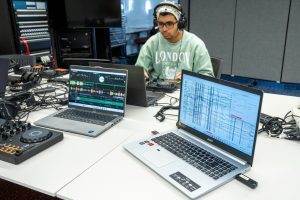
Test subjects sat in front of computers mixing music their heads bobbing to the beat as skull caps monitored their brain activity. Sixty students took part in the study which tests music-making as a creative, movement-based form of non-drug therapy. Half joined an eight-session DJing workshop using digital controllers and headsets. The other half served as a control group and watched hip-hop documentaries and music videos. Dr. Julia Basso Director of the Embodied Brain Laboratory.
“We’re hypothesizing that basically these kinds of programs will enhance mood and social attention, which we see with a lot of our dance programming as well, that it will enhance attentional focus,” said Dr. Julia Basso.
Basso teamed up with Craig Arthur and Dr. Frederick Paige are co-founders of Digging in the Crates Hip Hop Studies at Virginia Tech. The three wanted to answer the same question: Could producing music help people with ADHD regulate their attention, mood, and focus. Support from the Renée Fleming Neuroarts Investigator Award, helped fund the study. The hope is this will lead to a non-drug therapy.
“It’s ultimately different than taking a pill because there’s so many different neural pathways and neurochemistry that is altered from these very physical movements and kind of musical stimulation that you wouldn’t get from just like taking an antidepressant or taking a stimulant, for example,” explained Dr. Basso
Basso says they are using this semester to analyze the data they collected from the study. Denise Allen Membreno WFIR News.